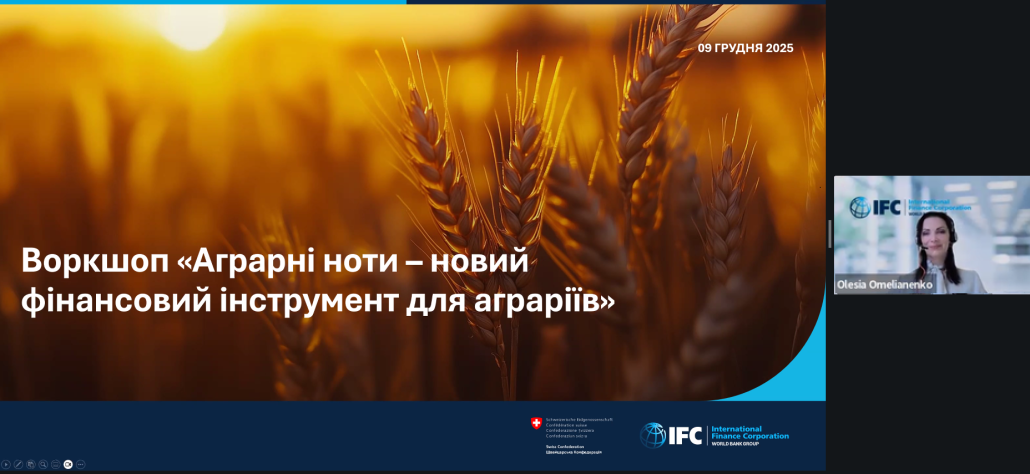
On 9 December 2025, the online workshop “Agrarian Notes – a New Financial Instrument for Agricultural Producers” took place. The event was organised with the support of Switzerland, at the initiative of the IFC Project “Ukraine Agriculture Capital Market Development”, in cooperation with the Swiss-Ukrainian Programme the Swiss–Ukrainian Programme “Higher Value Added Trade from the Organic and Dairy Sector in Ukraine” (QFTP) and other partners.
The workshop brought together more than 20 small and medium-sized agricultural producers of organic and non-organic products, as well as producers in conversion. Participants were introduced to an innovative financial instrument, agrarian notes, their key features, advantages, and opportunities for business development.
Agrarian notes are a modern digital instrument designed to simplify access to finance for agricultural producers. They can be issued online without the involvement of a notary, which significantly accelerates the process and makes it more accessible.
Unlike Agrarian receipts, agrarian notes may be secured not only by crop production, but also by livestock products and primary processing outputs. Agrarian notes can be issued by agricultural producers as well as by agricultural cooperatives and processors.
In his welcome remarks, Igor Kravchenko, Local Programme Manager of QFTP, stated:
“I would like to thank Switzerland for its support to Ukraine’s agricultural sector, thanks to which we were able to hold today’s workshop. I would also like to thank the IFC Project and our partners for their organisational and communications support, as well as the speakers for their expertise on the use of agrarian notes. It is particularly valuable that, despite these challenging times, you continue to develop the organic sector and Ukrainian agriculture. It is important that we are discussing new financial instruments for farmers today, as they open up access to capital, create additional opportunities for growth, and enhance the competitiveness of Ukrainian producers.”
Olesia Omelianenko, Outreach and Information Campaigns Consultant of the IFC Project, moderated the workshop and delivered a presentation on the concept and practical aspects of agrarian notes. She also outlined the background to the development of this instrument and the path taken to introduce it to the market.
During the event, participants received expert insights on:
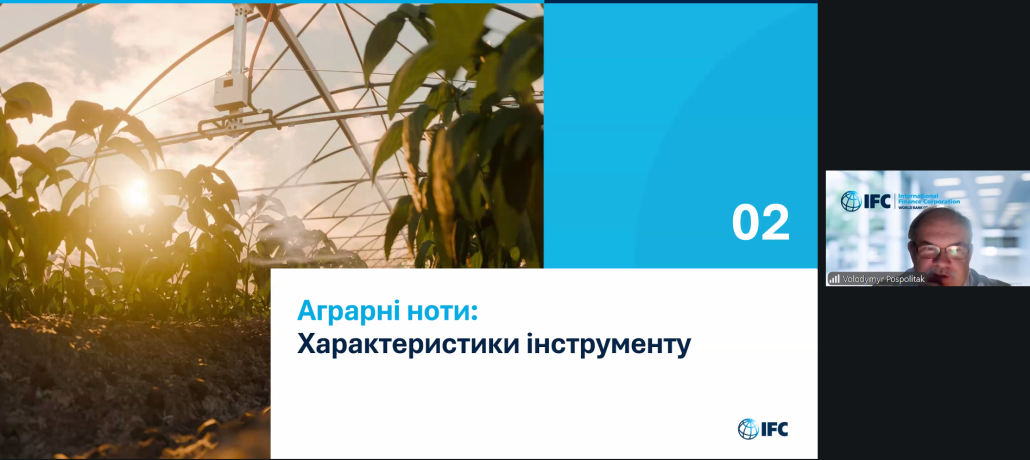
- key characteristics of agrarian notes, Volodymyr Pospolitak, Legal Advisor, IFC Project;
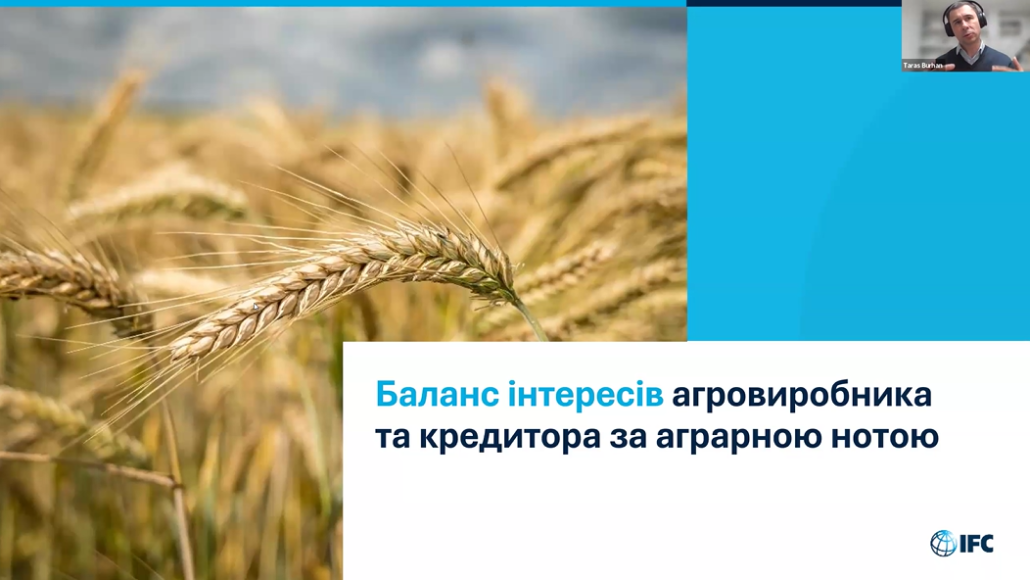
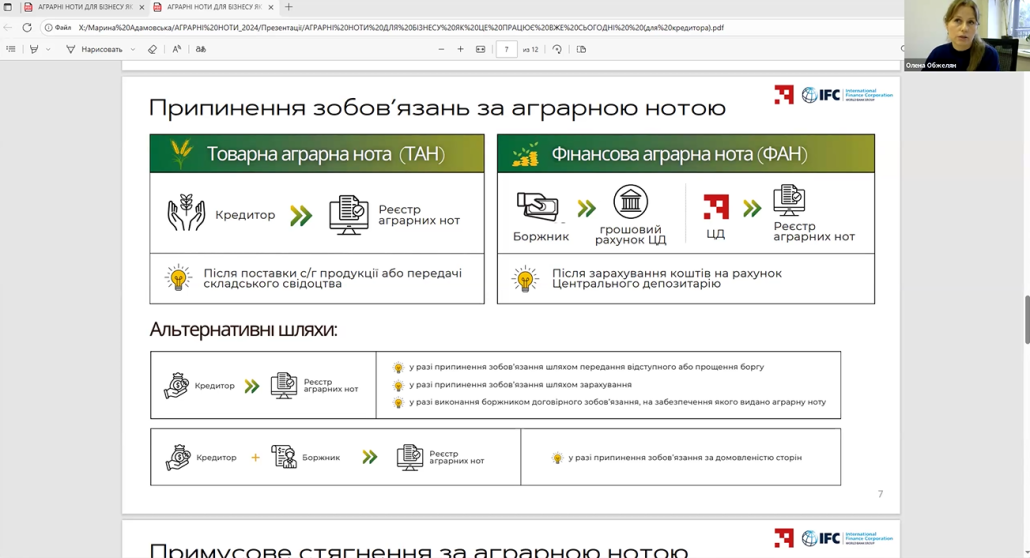
- collateral and fulfilment of obligations under agrarian notes, Taras Burhan, Legal Consultant, IFC Project;
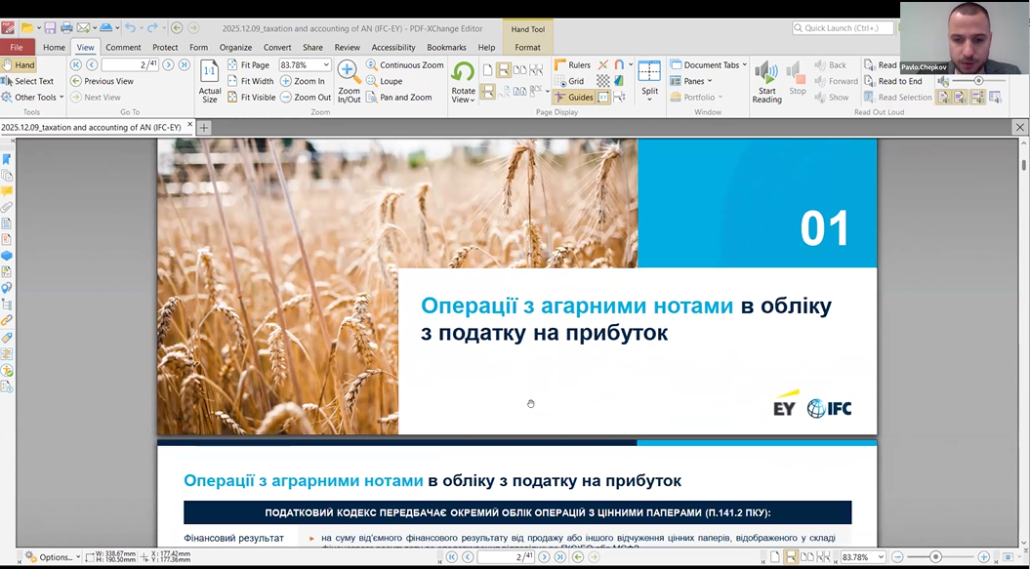
- taxation and accounting of agrarian notes, Pavlo Chepkov, Senior Consultant, EY Ukraine;
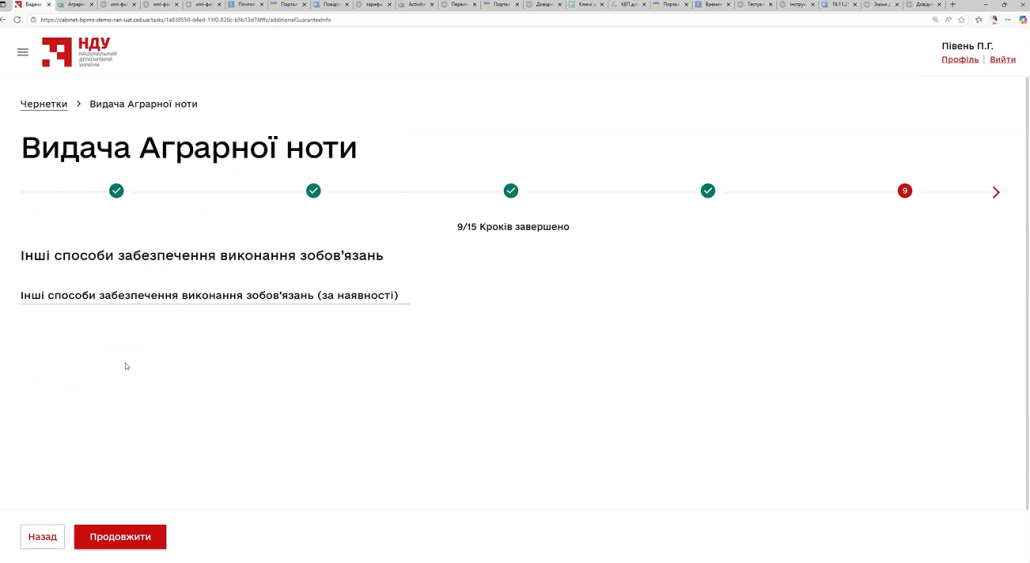
- practical cases, as well as recommendations on working with the electronic user account and the Agrarian Notes Register, Maryna Adamovska, Member of the Board of PJSC “NDU”, Olena Obzhelian, Head of the Legal Department of PJSC “NDU”, and Svitlana Sapanchuk, Head of Client Services Department of PJSC “NDU”.
The workshop confirmed the importance of digital financial instruments for the development of agribusiness in Ukraine, including the organic sector. The knowledge gained will help participants to plan financial decisions more effectively, expand partnerships, strengthen communication with creditors, and introduce innovations within their farms.
Event materials are available via the link (in Ukrainian).
The full recording of the workshop can be viewed on the QFTP YouTube channel at the link (in Ukrainian).
The workshop was organised at the initiative of the IFC Project “Ukraine Agriculture Capital Market Development”, implemented in partnership with the Swiss Confederation. The event was held in cooperation with the Swiss–Ukrainian Programme “Higher Value Added Trade from the Organic and Dairy Sector in Ukraine” (QFTP), funded by Switzerland and implemented by the Research Institute of Organic Agriculture (FiBL, Switzerland) in partnership with SAFOSO AG (Switzerland). Speakers from the National Depository of Ukraine and EY took part in the event. Organisational and communication support was provided by Organic Standard Certification Body and the Donau Soja Association.